Rigevidon: What You Need to Know
Reviewed by Usama Ali, MPharm (GPhC: 2224726). Last reviewed: October 2026.
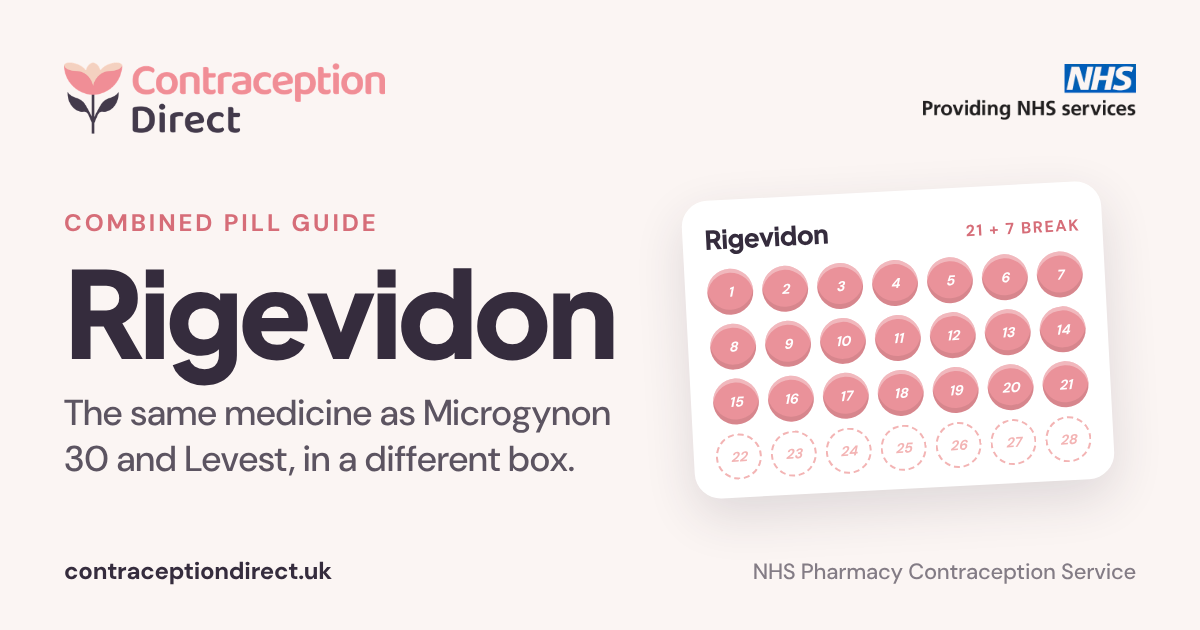
In a nutshell
Rigevidon is a combined contraceptive pill containing ethinylestradiol 30 micrograms and levonorgestrel 150 micrograms. It is clinically equivalent to Microgynon 30 and Levest. Levonorgestrel pills are among the combined pills with the lowest blood clot risk and are usually the first type offered.
Rigevidon is taken for 21 days followed by a 7 day break. It is available free on the NHS through the Pharmacy Contraception Service.
Quick facts
- Combined pill: 30 mcg ethinylestradiol plus 150 mcg levonorgestrel.
- Among the combined pills with the lowest blood clot risk.
- Clinically equivalent to Microgynon 30 and Levest.
- 21 days on, 7 days off. Free on the NHS.
Getting Rigevidon free on the NHS
Rigevidon is free on the NHS. A GPhC-registered pharmacist can supply levonorgestrel 150 microgram with ethinylestradiol 30 microgram pills (Microgynon 30, Rigevidon or Levest, depending on stock) through the NHS Pharmacy Contraception Service to people aged 16 to 49. A recent blood pressure reading is needed, and supply depends on the pharmacist's assessment.
What is Rigevidon?
Rigevidon is a combined contraceptive pill containing two hormones: ethinylestradiol (an oestrogen) at 30 micrograms and levonorgestrel (a progestogen) at 150 micrograms. It is manufactured by Gedeon Richter.
Rigevidon is the same medicine as Microgynon 30, Levest, and Ovranette. All four brands contain ethinylestradiol 30 micrograms and levonorgestrel 150 micrograms. The only differences are the manufacturer, the packaging, and some inactive ingredients. The contraceptive effect is identical. For a side by side comparison, read Microgynon vs Rigevidon.
Levonorgestrel combined pills are the most commonly prescribed type in the UK and are usually the first combined pill offered. They are among the combined pills with the lowest blood clot risk, which is why the FSRH considers them first-line.
Is Rigevidon a combined pill or a mini pill?
Rigevidon is a combined pill, not a mini pill. Each tablet contains two hormones, ethinylestradiol 30 micrograms (an oestrogen) and levonorgestrel 150 micrograms (a progestogen). The mini pill contains a progestogen only. Because Rigevidon contains oestrogen, it needs a blood pressure check and is not suitable for everyone who can take a mini pill.
If you cannot take oestrogen, for example because you get migraine with aura, smoke and are 35 or over, or have had a blood clot, a progestogen-only pill such as desogestrel is the usual alternative. Our guide to the combined pill versus the mini pill compares the two.
How does Rigevidon work?
Rigevidon prevents pregnancy in three ways. It stops your ovaries from releasing an egg each month. It thickens the mucus at the cervix, making it harder for sperm to reach an egg. And it thins the lining of the womb, reducing the chance of a fertilised egg implanting.
Taken correctly, Rigevidon is more than 99% effective. With typical use (where pills are occasionally missed or taken late), effectiveness is around 91% (FSRH, 2023).
How do you take Rigevidon?
Take one tablet at the same time each day for 21 days. Then have a 7 day break during which you will usually get a withdrawal bleed. After the 7 days, start the next pack. The withdrawal bleed is not a true period. It happens because hormone levels drop during the break.
Rigevidon has a 24 hour late window. If you take it less than 24 hours late, you are still protected. If you miss it by more than 24 hours, follow the missed pill guidance in the patient information leaflet or use our missed pill tool.
If you start Rigevidon on day 1 of your period, you are protected straight away. If you start on any other day, use condoms for the first 7 days.
Is Rigevidon the same as Microgynon and Levest?
Yes. Rigevidon, Microgynon 30, and Levest contain the same two active ingredients at the same doses. They work in the same way, have the same effectiveness, carry the same risks, and produce the same side effects. The only difference is who makes them.
| Brand | Active ingredients | Manufacturer | Clinically equivalent? |
|---|---|---|---|
| Microgynon 30 | EE 30mcg + LNG 150mcg | Bayer | Reference product |
| Rigevidon | EE 30mcg + LNG 150mcg | Gedeon Richter | Yes |
| Levest | EE 30mcg + LNG 150mcg | Morningside Healthcare | Yes |
| Ovranette | EE 30mcg + LNG 150mcg | Pfizer | Yes |
If your pharmacy switches you from Microgynon to Rigevidon, or from Rigevidon to Levest, the medicine has not changed. Under the NHS, pharmacies are expected to supply the most cost-effective product. This is why switches happen and why they are nothing to worry about.
"People often ask us whether Rigevidon is as good as Microgynon," says Usama Ali, MPharm (GPhC: 2224726), pharmacist at Contraception Direct. "It is the same medicine. The active ingredients and doses are identical, so the contraceptive effect is exactly the same."
What are the side effects of Rigevidon?
Rigevidon side effects listed as common in the patient leaflet (up to 1 in 10 people) include feeling or being sick, abdominal pain, breast tenderness, mood swings including low mood, acne, changes in weight, fluid retention and lighter or absent withdrawal bleeds. Most appear in the first 2 to 3 months and settle as your body adjusts.
The table groups the side effects in the Rigevidon patient information leaflet by how often they are reported. Microgynon 30 and Levest contain the same two hormones at the same doses. The Microgynon 30 leaflet also lists headache as common, and notes that spotting between periods can happen in the first few months.
| How often | Side effects reported with Rigevidon |
|---|---|
| Common (up to 1 in 10 people) | Feeling or being sick, abdominal pain, breast tenderness, pain, enlargement or discharge, mood swings including depression, changes in interest in sex, nervousness, dizziness, acne, painful periods, lighter or absent bleeding, fluid retention, changes in weight, vaginal thrush or discharge |
| Uncommon (up to 1 in 100 people) | Raised blood pressure, changes in appetite, abdominal cramps or bloating, rash, chloasma (brown patches on the skin), excess hair growth, hair loss, changes in blood fats |
| Rare (up to 1 in 1,000 people) | Blood clots in a vein or artery (deep vein thrombosis, pulmonary embolism, heart attack, stroke), severe allergic reaction, jaundice, erythema nodosum (painful red skin lumps), eye irritation with contact lenses, glucose intolerance |
Some people find the combined pill helps with period pain, heavy periods and premenstrual symptoms. Others notice a small rise in blood pressure or changes in libido. These effects are the same across all levonorgestrel combined pills because the active ingredients are the same.
Seek urgent medical help, by calling 999 or going to A&E, if you get painful swelling in one leg, sudden chest pain or breathlessness, a severe or unusual headache, sudden changes in your vision, or weakness or numbness on one side of your body. These can be signs of a blood clot.
For a full breakdown of what to expect, read our guide on side effects of the pill.
Does Rigevidon cause weight gain?
Rigevidon lists changes in weight as a common side effect, affecting up to 1 in 10 people, and that can mean gain or loss. FSRH guidance says the available evidence does not show that the combined pill causes weight gain (FSRH, 2023). Fluid retention, also a listed side effect, can explain small changes early on.
If your weight changes and it bothers you, speak to your pharmacist. Switching to a different pill is straightforward. The progestogen-only pill is an option, although the evidence on weight is much the same. Our guide on the mini pill and weight gain explains it.
Does Rigevidon affect your mood?
Rigevidon can affect mood in some people. Mood swings, including depression, are listed as a common side effect in the patient leaflet, affecting up to 1 in 10 people, usually in the first few months. Many people notice no change, and some find premenstrual mood symptoms ease.
If low mood persists, speak to a pharmacist or GP. If you have thoughts of harming yourself, get help the same day from your GP or NHS 111, or call 999 in an emergency. Do not stop the pill without another method of contraception in place.
A different combined pill, or a progestogen-only pill, may suit you better. Our guide on the pill and your mood covers what the evidence shows and when to switch.
What about blood clot risk?
All combined pills carry a small increased risk of venous thromboembolism (blood clots). Levonorgestrel pills like Rigevidon are among the combined pills with the lowest risk.
| Group | Blood clots per 10,000 users per year |
|---|---|
| Not using hormonal contraception | About 2 |
| Levonorgestrel combined pill (Rigevidon, Microgynon, Levest) | 5 to 7 |
| Drospirenone combined pill (Yasmin, Lucette) | 9 to 12 |
| During pregnancy | About 29 |
These figures come from the FSRH Combined Hormonal Contraception guideline. The risk is real but small. This is one reason why levonorgestrel pills are offered first.
The mini pill is not thought to raise blood clot risk in the way the combined pill does. If clot risk is a concern for you, it is a suitable alternative. For more detail, read our guide on the pill and blood clots.
Who can take Rigevidon?
Rigevidon is suitable for most people aged 16 to 49 through the NHS Pharmacy Contraception Service. Your pharmacist checks your medical history, takes a blood pressure reading (within the last 12 months), and calculates your BMI before supplying it.
Rigevidon is not suitable if you have a history of blood clots (DVT or PE), experience migraine with aura at any age, smoke or vape and are 35 or over (or stopped less than a year ago), have a BMI of 35 or above, have high blood pressure (140/90 mmHg or higher when measured by a pharmacist or GP, or 135/85 or higher on a home monitor) or take medicine for it, or are breastfeeding in the first 6 weeks after birth.
If the combined pill is not suitable for you, the mini pill is usually a good alternative. It does not contain oestrogen and has fewer contraindications.
Can you skip your period on Rigevidon?
Yes. You can run packs back to back by skipping the 7 day break and starting a new pack straight away. This means you skip the withdrawal bleed. Current FSRH guidance supports this approach and confirms it is safe to do regularly. Taking packs back to back is outside the pill's licence, so check with your pharmacist first.
You may get some breakthrough bleeding or spotting, especially in the first few months of running packs together. This usually settles over time.
Some people prefer to take a shorter break (4 days instead of 7) to reduce the risk of ovulation during the break. Your pharmacist can explain the different regimens if you are interested.
How to get Rigevidon free
Rigevidon is available free on the NHS through your GP, a sexual health clinic, or a pharmacy through the NHS Pharmacy Contraception Service. With Contraception Direct, you book a free phone consultation, your pharmacist checks your suitability, and your pill is posted in discreet packaging within 1 to 3 working days.
Under the PCS, your pharmacist supplies the most cost-effective levonorgestrel combined pill available. You may receive Rigevidon, Microgynon, Levest, or Ovranette. They are all the same medicine.
If you are currently on Rigevidon and want to continue, want to switch from another pill, or want to start for the first time, book a consultation. Your pharmacist will confirm whether it is right for you.
Frequently asked questions
- What is Rigevidon?
- Rigevidon is a combined contraceptive pill containing ethinylestradiol 30 micrograms and levonorgestrel 150 micrograms. It is taken once a day for 21 days, followed by a 7 day break. It is clinically equivalent to Microgynon 30 and Levest.
- Is Rigevidon the same as Microgynon?
- Yes. Both contain ethinylestradiol 30 micrograms and levonorgestrel 150 micrograms. They are the same medicine made by different manufacturers. Microgynon is made by Bayer, Rigevidon by Gedeon Richter. The contraceptive effect is identical.
- Is Rigevidon the same as Levest?
- Yes. Levest also contains ethinylestradiol 30 micrograms and levonorgestrel 150 micrograms. If your pharmacy switches you between Rigevidon, Levest, and Microgynon, the medicine and the contraceptive effect are the same.
- What are the side effects of Rigevidon?
- Common side effects include headaches, nausea, breast tenderness, mood changes, and breakthrough bleeding. These usually settle within 2 to 3 months. Rigevidon carries a small increased risk of blood clots, as all combined pills do.
- How late can I take Rigevidon?
- Rigevidon has a 24 hour late window. If you take it less than 24 hours late, you are still protected. If you miss it by more than 24 hours, follow the missed pill guidance or use our missed pill tool.
- Is Rigevidon a mini pill?
- No. Rigevidon is a combined pill, containing both an oestrogen (ethinylestradiol) and a progestogen (levonorgestrel). The mini pill contains only one hormone. If you cannot take oestrogen, a mini pill may suit you better.
- How long does Rigevidon take to work?
- If you start Rigevidon on the first day of your period, you are protected straight away. If you start at any other time, use condoms for the first 7 days of taking it.
- Can I skip my period on Rigevidon?
- Yes. You can run packs back to back by skipping the 7 day break. This is outside the pill's licence, but FSRH guidance supports it and it is safe to do regularly. You may get some breakthrough bleeding, especially at first.
- What can I use as an alternative to Rigevidon?
- Microgynon, Levest, and Ovranette are the same medicine and are direct alternatives. If you cannot take oestrogen, a progestogen-only mini pill is a suitable alternative. Your pharmacist will help you choose based on your medical history.
This information is for general guidance only and does not replace advice from a clinician, pharmacist, or doctor. A clinician will review your consultation before any medication is supplied.
References
- BNF. Levonorgestrel with ethinylestradiol. British National Formulary.
- FSRH. Combined Hormonal Contraception Clinical Guideline, January 2019 (amended October 2023).
- CoSRH. UK Medical Eligibility Criteria for Contraceptive Use (UKMEC 2025), December 2025.
- NHS. Combined pill.
- NHS England. Community Pharmacy Advanced Service Specification: NHS Pharmacy Contraception Service. Version 3.0, October 2025.
Get Rigevidon free
Book a free phone consultation with a pharmacist. If Rigevidon or an equivalent levonorgestrel pill is right for you, it arrives in discreet packaging within 1 to 3 working days.
No GP needed. No prescription charge. The consultation, the pill, and the delivery are all free.